|
|
|
|
HOSPITAL CHARITY BEDS
Part 3
|
|
Similar to Birdie’s experience that I shared in part 2, a hospital setting is for curative or maintenance care, not comfort. Hospitals often lack clinicians trained in end-of-life care, and even if they are present, they don't have time to support and accompany those who are dying.
|
|
Also, the hospital administrators do not want patients dying in their hospital. They will be penalized by Medicare if the mortality rate is too high. Therefore, the concern about being ignored is not the biggest moral issue at hand. The primary concern is a patient being overly treated against their will.
|
There are worse things than death!
|
|
|
|
Heart of Mary House is gradually becoming an education hub for families experiencing situations such as these. Even if we cannot provide direct help, we will offer resources and communications to empower families to better advocate for and accompany their loved ones at the end of life.
|
|
We only lose our mother or father once, our sister, brother, child, etc...
|
|
We want to make sure everyone is equipped with a happy and holy death,
|
|
|
|
-Meet Judy-
|
|
|
|
|
|
We received a referral from an area hospital for a woman who had suffered a stroke. Judy was living a typical independent life prior to the stroke. She was a gardener and enjoyed reading and life outdoors. Suddenly, she was in the hospital, unable to speak, unable to move on her own and unable to care for herself.
|
Judy had two children; one was a daughter who lived in Kentucky and was physically disabled. The other was a son, who had mental handicaps and he and Judy had been estranged.
|
Judy did not qualify for Medicaid and could not afford a nursing home in addition to the extra care she now required.
|
While in the hospital, she was declining quickly. Originally, when the referral was made, we were full and had no beds available. Every few days, the case manager from the hospital would call to see if a room had become available.
|
On one of the calls the case manager shared with me that Judy’s room was at the far end of the hall and that she never had any visitors. She said the room was often dark and food trays were just left on the bedside table, with no one willing or able to feed her.
|
She had not lost the ability to swallow, but was placed on ‘swallow precautions,’ which is incredibly common for the people we receive in our home (more on that subject at another time).
|
Finally, after nearly three weeks, a bed opened up and we were able to receive Judy. When Judy arrived, I will never forget what struck me the most; it was her hair!
|
She had grey roots that were a couple of inches long. My heart could not escape the realization that this was a woman who took pride in her appearance, who just a few weeks prior was sitting at a beauty parlor getting her hair colored. This was a person living a full life, doing ordinary things, enjoying her hobbies and living her life to the fullest. In the outdoors, she was likely befriended by nature and found solace in His creation.
|
But she was far from that peaceful place while in the hospital. She was in the dark, cold loneliness of the sterility of 'health care.'
|
By God's grace, she was now in our care. Yes, she was dependent on strangers, but the strangers were heaven sent and welcomed her with loving arms. She was safe and she was loved.
|
Another thing I will never forget is the sound of her stomach when she swallowed her first bite of applesauce. When we offered it, she ate it without any trouble at all. When a stomach has been empty for many days, and food is introduced, it growls in a particular way as air and liquid meet for the first time in a long time. It was heart wrenching to hear the sounds coming from her stomach afterwards as I knew that her stomach was ‘waking up’ to the reception of food and nourishment.
|
It is difficult to express other observations without demeaning her, but I can only think to describe the entire state of her being as if she were mummified—like she was deceased from the inside out; as if she had just been left to die in the back corner of a hospital, yet, she didn't!
|
Judy was fully alive and her purpose was still in God's hands! She was not with us for very long, but she was with us for as long as the Lord saw necessary. She was given the presence of people, of love and dignity.
|
As someone who likes to garden, myself, there is a connection to God we gardeners feel when we are knee deep in dirt and planting our favorite flowers to provide food for the hummingbirds and butterflies. I couldn’t help but think of how her days spent tending to God's harvest meant she must have also known and believed in His promises and learned from the wildflowers that He would tend to her needs.
|
Judy was now the wildflower and we were blessed with tending to her care.
|
|
|
|

|
|
|
Therefore do not worry,
saying, "What will we eat?"
"What will we drink?"
"What will we wear?"
(Matthew 6:31)
|
|
|
|
|
|
Judy's death was preserved from the dark, cold, isolating room in the back corner of the hospital and instead her death was brought into the light of Christ at Heart of Mary House. It was as happy as it could have been and holier than she likely ever imagined!
|
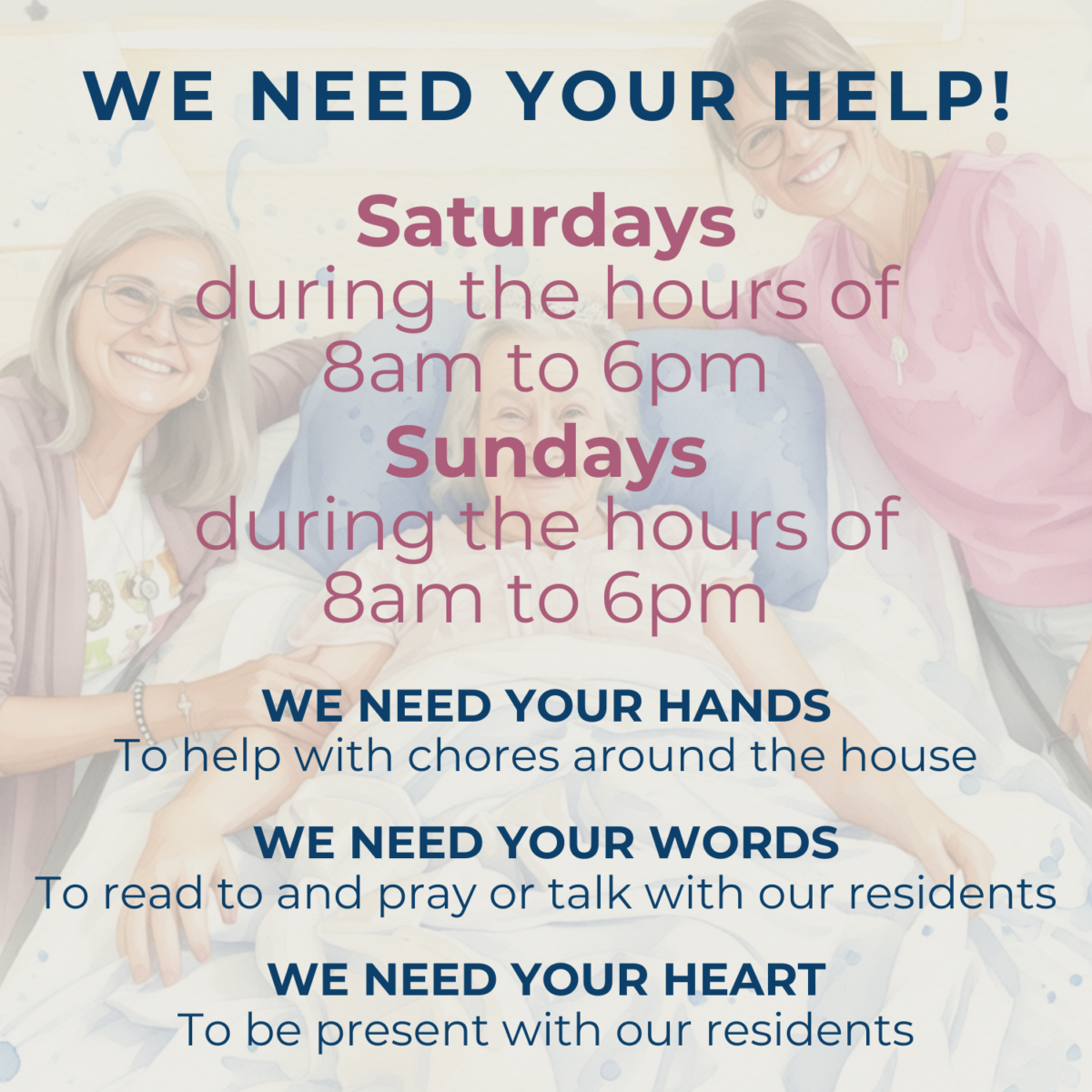
Thank you, Jesus, for allowing us to care for Judy during the most sacred time of her life! Thank you to our donors and volunteers who participated in Judy's care and were key contributors to building the kingdom of God!
|
|
|
|
|
|
|
|
|
|
|